
Texas SB 458 Appraisal Law changes how many residential property insurance policies in Texas handle disagreements about the value of damage after a covered claim.
Beginning with policies delivered, issued, or renewed on or after January 1, 2026, most personal residential and auto insurance policies in Texas must include a binding appraisal process for disputes about the amount of loss.
For Texas homeowners—particularly in storm-exposed regions such as Dallas–Fort Worth and North Texas—this law standardizes how valuation disagreements may be resolved when the policyholder and insurer cannot agree on repair costs.
This guide explains what SB 458 does, what it does not change, and how it may affect Texas homeowners navigating property damage claims.
What Texas SB 458 Changes in Residential Insurance Policies
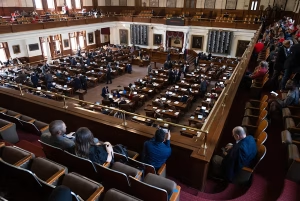 SB 458 requires most personal residential property and auto policies issued or renewed after January 1, 2026 to include an appraisal provision addressing valuation disputes on covered losses.
Appraisal is a contractual process used when:
-
Damage is acknowledged as covered
-
The parties disagree on value
-
The dispute concerns repair or replacement cost
Under SB 458-compliant policies:
-
The policyholder selects an appraiser
-
The insurer selects an appraiser
-
The appraisers attempt agreement
-
If needed, a neutral umpire participates
-
Agreement by any two determines the amount of loss
The appraisal determination is binding as to valuation, subject to limited legal exceptions recognized under Texas law.
SB 458 does not create appraisal; appraisal already existed in many policies.
The law standardizes its inclusion across most personal residential policies once it applies to a policy.
Why Texas Adopted SB 458
Before SB 458, appraisal availability varied across insurers and policy forms.
Some policies contained detailed appraisal clauses.
Others contained minimal or modified provisions.
Some policies removed appraisal entirely.
This variability meant Texas homeowners had different valuation dispute procedures depending on insurer and policy form.
SB 458 addresses this inconsistency by requiring appraisal inclusion in most personal residential policies issued or renewed after January 1, 2026.
The law focuses on procedural uniformity rather than claim outcomes.
WHAT SB 458 MEANS FOR DALLAS AND NORTH TEXAS HOMEOWNERS
North Texas experiences frequent hail, wind, and water-related residential losses.
In these environments, disagreements about repair cost estimates are common.
SB 458 standardizes appraisal availability in this context by requiring covered policies to include a valuation dispute mechanism.
For homeowners in Dallas–Fort Worth and surrounding regions, this means:
-
Appraisal availability becomes consistent across most insurers
-
Valuation disputes follow defined policy procedures
-
Appraisal clauses are expected in 2026-and-later policies
-
Policy wording governs timing and requirements
SB 458 does not affect claim frequency or damage patterns.
It affects only how valuation disagreements may be resolved under applicable policies.
 What SB 458 Does Not Change
SB 458 is limited to valuation procedure.
It does not alter core insurance coverage terms.
The law does not:
-
Expand coverage
-
Reduce deductibles
-
Change exclusions
-
Require claim payment
-
Determine claim eligibility
-
Resolve coverage disputes
Coverage determinations remain governed by:
-
Policy language
-
Claim facts
-
Applicable insurance law
Appraisal applies only after coverage is acknowledged and valuation disagreement exists.
Policies Covered by SB 458
SB 458 applies broadly across the Texas personal residential insurance market.
Covered policy types include:
-
Stock insurance companies
-
Mutual insurers
-
Lloyd’s plans
-
Reciprocal exchanges
-
County mutual insurers
-
FAIR Plan residential policies
-
Certain surplus-lines residential policies (Texas home state)
This captures most owner-occupied residential homeowners policies in Texas once renewed after January 1, 2026.
Policies Not Covered by SB 458
SB 458 does not apply to all property insurance.
Excluded policy types include:
-
Commercial property policies
-
Texas Windstorm Insurance Association (TWIA) policies
Owners of rental portfolios, commercial buildings, or coastal TWIA-insured properties should review individual policy appraisal provisions rather than assuming SB 458 applicability.
When SB 458 Applies to a Policy
SB 458 is not retroactive.
The statute applies only to policies:
-
Delivered
-
Issued
-
Or renewed
on or after January 1, 2026.
Policies issued before that date retain existing appraisal language until renewal.
The law itself took effect September 1, 2025, but application to policies begins January 1, 2026.
How the SB 458 Appraisal Process Works
SB 458 standardizes appraisal inclusion but the operational process remains defined by policy language and applicable rules.
Typical appraisal structure:
-
Coverage acknowledged
-
Valuation disagreement identified
-
Appraisal invoked under policy
-
Each party selects appraiser
-
Appraisers evaluate loss
-
Umpire participates if needed
-
Two-of-three agreement reached
-
Binding valuation determined
Appraisal resolves the dollar value of covered damage only.
Binding Nature of SB 458 Appraisal
 Texas SB 458 Appraisal Law. Once appraisal concludes, the amount of loss determined by the panel is generally binding on both parties.
Limited exceptions may exist under Texas law, including:
-
Fraud
-
Lack of authority
-
Material mistake
SB 458 does not change these established legal principles.
It standardizes appraisal inclusion, not judicial review standards.
Costs Associated with Appraisal
SB 458 makes appraisal available but does not eliminate costs.
Typical appraisal-related expenses may include:
-
Policyholder appraiser fees
-
Shared umpire fees
-
Supporting documentation work
-
Expert or estimating support
Costs vary by claim complexity, dispute size, and professional rates.
SB 458 does not regulate fee levels or cost allocation beyond policy provisions and general law.
SB 458 vs Litigation in Texas Property Claims
Appraisal and litigation address different dispute types.
Appraisal
-
Resolves amount-of-loss disputes
-
Uses valuation professionals
-
Produces binding valuation determination
-
Does not address coverage
Litigation
-
Addresses coverage disputes
-
Applies legal interpretation
-
May involve courts or juries
-
Can resolve statutory issues
Both mechanisms may occur within a claim if disputes differ in nature.
Role of the Texas Department of Insurance (TDI)
SB 458 directs the Texas Department of Insurance (TDI) to adopt rules addressing appraisal timing and qualifications.
The statute establishes:
-
Mandatory appraisal inclusion
-
Commissioner rulemaking authority
Operational details are expected to be governed by:
-
TDI rules
-
Policy language
-
Regulatory guidance
Homeowners must review both policy provisions and applicable TDI rules to understand appraisal requirements.
Practical Impact of SB 458 on Texas Claims
SB 458 primarily affects valuation dispute procedure.
After SB 458 applies to a policy:
-
Appraisal clauses are expected in most residential policies
-
Valuation dispute procedures become more uniform
-
Policy language governs invocation and timing
-
Appraisal becomes consistently available
However, most claims will continue resolving through ordinary adjusting without appraisal.
SB 458 affects disputed valuation scenarios rather than routine claims.
Documentation and Valuation in SB 458 Context
Appraisal decisions rely heavily on documented property conditions and repair scope information.
Common valuation inputs include:
-
Property inspection observations
-
Photographic documentation
-
Repair estimates
-
Scope comparisons
-
Construction pricing data
SB 458 does not define documentation standards.
Evidence requirements remain governed by appraisal practice and policy context.
How Recourse Supports SB 458-Related Claims
BestRecourse provides inspection-based documentation and appraisal support services related to property damage valuation.
Services may include:
-
Property condition documentation
-
Estimate and scope review
-
Photo reporting
-
Loss valuation analysis
-
Appraisal preparation support
BestRecourse services relate only to amount-of-loss documentation and appraisal processes.
BestRecourse:
-
Does not interpret insurance policies
-
Does not provide legal advice
-
Does not negotiate or settle claims
-
Does not determine coverage
FAQ: Texas SB 458 for Homeowners
What is SB 458 in simple terms?
A Texas law requiring most personal residential and auto policies issued or renewed after January 1, 2026 to include appraisal for valuation disputes on covered claims.
Does SB 458 apply to my current homeowners policy?
Only if the policy is delivered, issued, or renewed on or after January 1, 2026.
What disputes go to appraisal under SB 458?
Only disagreements about the value of covered damage.
Does SB 458 change coverage?
No. Coverage remains defined by the policy.
Is appraisal binding?
Binding as to amount of loss, subject to limited legal exceptions.
Does SB 458 apply to TWIA?
No.
Does SB 458 apply to commercial property?
No.
Do all insurers have to include appraisal after 2026?
Most personal residential insurers must include appraisal once SB 458 applies to the policy.
How can BestRecourse help?
By providing inspection-based documentation and valuation support for appraisal-related disputes.
Key Takeaways for Texas Homeowners
SB 458 is a procedural reform affecting valuation disputes in many Texas residential policies beginning in 2026.
Homeowners should understand:
-
It applies to most personal residential policies after renewal
-
It addresses valuation only
-
Coverage remains unchanged
-
Policy wording and TDI rules govern details
SB 458 does not change claim eligibility or payment requirements.
It changes how valuation disagreements may be resolved.
Texas SB 458 standardizes appraisal availability in many Texas residential policies beginning in 2026.
Homeowners reviewing property damage estimates or preparing for potential valuation disputes may learn more about inspection-based documentation and appraisal support services at BestRecourse.com.
BestRecourse provides inspection, estimating, documentation, education, and appraisal services limited to the amount of loss.
BestRecourse does not interpret policies, provide legal advice, or negotiate or settle insurance claims.
For general consumer information, homeowners may also review resources from the Texas Department of Insurance.